Saturday, November 4, 2017

It’s Time to Email Everyone Again, Having Become Convinced No One is Paying Any Attention.


So, the Graduation Crisis is once again a problem. The Graduation Requirement has not changed, so obviously there’s still a problem, unless teachers like myself, and our students have pulled ourselves up by our bootstraps in some ridiculous manipulation of an American Dream that is dependent upon the passage of a standardized test. 

I find the entire argument exhausting anymore, and to be honest, I find its impact on my job untenable. 

As I’ve been arguing for years, the grad requirement is nonsense, so I’ve written the members of the House and Senate Education Committees, or whatever they’re calling them now. We’ve traveled long enough with this testing scenario. It’s time for something more intellectual, more thoughtful, more meaningful. Here’s my letter...

Senator...


I have spent the better part of the last three years corresponding with you, and other legislators about a problem with the graduation requirement. As a teacher in an urban high school, Elyria, I felt that I had some insight on the issue. My students were in danger of not graduating, largely due to an unfair and unnecessary assessment system. They still are. Unfortunately, the Ohio Senate and House of Representatives, as well as the State School Board, has been reluctant to listen, to provide a permanent solution, though a legitimate attempt to assist the class of 2018 was included in the budget bill.


All available evidence provided by the Ohio Department of Education, regardless of their positive spin, indicates that this year’s juniors are in essentially the same situation as last year’s. Statistics indicate that only 65% of this year’s juniors are likely or highly likely to graduate under the assessment system. As you would imagine, the situation is worse in Ohio’s impoverished urban centers.


It is long past time to change the current system. In January of this year, I wrote the following, and I would encourage you to revisit it, and move forward for the sake of Ohio’s students.


If we are to move toward excellence in education, we should be more concerned with providing opportunities for students, as opposed to doling out punishments. In that, education on the whole needs to become less reliant on the weight of standardized test scores which have always, though especially recently, provided negligible data. If it is philosophically impossible to eliminate standardized tests as a determinant for graduation (federal law does not require it), then they should at least be limited to something akin to the OGT. In combination with this, the point totals necessary for graduation should be lowered AND additional ways of earning points should be established. Standardized tests do not measure, nor do they promote, career or college readiness. They also do not begin to convey the level of work that is required of a student through the process of their education. Offering points for active participation in student groups, service organizations, taking on leadership roles, internships or employment, course grades, extracurriculars and otherwise should be considered.


Yours in education,

Matthew T. Jablonski


Wednesday, October 18, 2017

A Few Run on Sentences Regarding the Exaggerated Demise of the Graduation Problem.


One: Not Encouraging.

This week, Ohio’s School Board was entertained with a presentation from the Ohio Department of Education, seemingly meant to diminish any lingering concern regarding the Graduation Crisis, in which they illustrated the “encouraging” news that 77% of Ohio’s seniors (according to their estimates) are on track to graduate - encouraging despite only 50% of urban very high poverty students being “on track,” despite the fact that this year’s juniors, the class of 2019, are in essentially the same place as their predecessors in their assessment related progress to graduation.

Two: Legislate for All Students.

Because the poor, with terribly immediate issues with which to deal (like multiple jobs, food insecurity, subsequent health issues, lack of transportation) are less likely to have enough time to devote to simply understand the convoluted Graduation Requirement, or apply political pressure, or voice their concerns to the media, the O.D.E., State Superintendent, and legislators seem to believe that they can create policy that exacerbates the systemic inequality prevalent in our society, as the shameless spinning of this grad data proves.

Three: Cycle.

Insisting on success within an assessment system that reflects little more than economic standing as contingent for a high school diploma does little more than assure that the “have-nots” will not graduate, will be wholly unable to continue their education, so subsequently only qualify for low-paying jobs, and assure the continued “economic disadvantage” for themselves in their lifetime, and their children in theirs.

Four: Shut Up.

The insistence from Columbus on the unproven lie that success on state assessments somehow equates to career or college readiness is not helping boost achievement for Ohio’s students, when education practitioners from all corners of the state understand completely that the system is a sham, limited at best in its ability to measure anything, and yet still being wielded as a weapon to punish children and their teachers while being disguised as a mechanism for improvement with phrases like “they have answered the call” or “they have stepped up to the challenge.”

Five: Chad.

Chad Aldis of the Fordham Foundation believes we teachers and students have stepped up to the challenge of tougher expectations on the new assessments, and that the grad crisis isn’t what we thought it was, and all sorts of other bullshit he thinks we’re listening to, even though we know that he’s an advocate for charter schools who benefit from the failure of public schools on an assessment system (that essentially measures economics), through the opening of districts to new charters, or the complete CEO-style takeover of districts like Youngstown and Lorain.

Assessments benefit the people you work for, Chad, we get it.

Six: The Reality.

There is still a Graduation Problem, if not a Crisis.

Thousands of students will be prevented from graduating because of a flawed assessment system.

Those students left without diplomas will be disproportionately economically disadvantaged.

This is criminal.

Saturday, September 16, 2017

Same With the State Report Card.

The Ohio State Report Cards were released this week, so as a teacher in an urban district, I've been splitting my time between rage and despondency. I've also been fighting a cold while trying to motivate, educate, and entertain about 150 10th grade American History students who attend a school that received a few F's, a D, and a lone C in Graduation Rate. Needless to say, this is not the assessment of my building that I would levy, and I don't think that my students or their parents, even on a bad day, would give us marks that low.

But the state is another story, as they have no issue doling out notifications of failure. Sure there are disclaimers, like this one on the Report Card page, "Report Cards are only one part of the story of what is happening in a district or school. To get a fuller picture, visit schools, talk to teachers, administrators, parents and students..." 

State Superintendent Paolo DeMaria has also continued his tour of relentless positivity pointing out, "Having set high expectations for what our students must know and be able to do, our children and schools are stepping up to the challenge. We’re seeing increases in achievement across the state. I continue to be impressed with the dedication of Ohio’s educators and our students’ desire to learn more and more.”

The problem, even if there are widespread increases in achievement on these tests (and I'm not sure that's true), is that no one is listening to the Superintendent, and no one is visiting schools. Most people are not even visiting the state website. The only piece the average citizen is interested in is the annual Performance Index ranking of school districts published in the paper.

With the exception of a majority of the Ohio Legislature and anyone currently employed by the Ohio Department of Education, anyone who's done any rudimentary research into what it is that standardized tests really measure (and in turn the district rankings) will tell you that it's a measure of economics. So, when news outlets echo the state's rhetoric and explain that the state changed the testing system "in an effort to demand higher performance from students," it is complete bullshit. When they add that students arrive at college unprepared for college work, they're off target because everyone worth their salt in education knows that assessments are not a good predictor of college success. GPA is the best predictor of college success. Standardized assessments are best at identifying socioeconomic status, which is information we could gain from the IRS without hundreds of hours of test prep and testing.

If you don't believe me, then check out the information below which examines Ohio's state report card ranking by Performance Index, as it relates to median income, average income, and relative poverty in a given district. The first image is the top 30 schools, and the second is the bottom 30 schools.


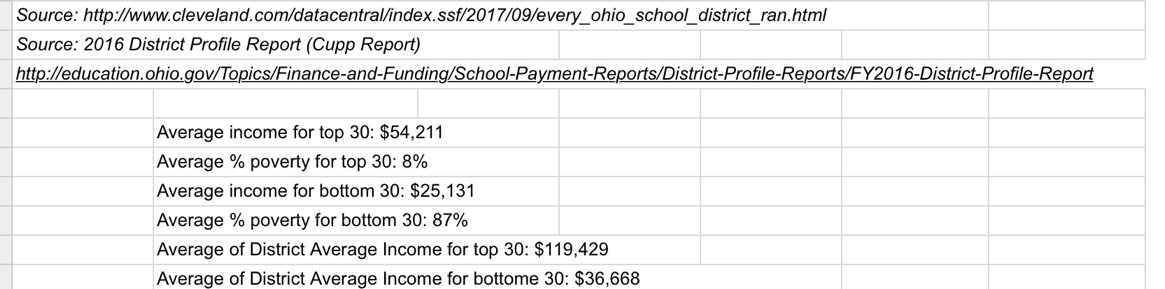


The differences top to bottom are stark, from a district with zero poverty in the top 30, to districts with 100 percent poverty in the bottom 30. The averages are, perhaps, even more telling. Top 30 average median income: $54,211, average poverty: 8%. Bottom 30 average median  income: $25,131, average poverty: 87%. 

The average household income for districts in the top 30 PI ranking is $119,429. The average household income for those in the bottom 30 is $36,668. This is what our state assessments measure.

This is not new. Sure the incomes and poverty levels may fluctuate, school districts may swap spots. You might even catch a high poverty district move up, or a low poverty district drop in the rankings, but the correlation is there, year after year.

What really makes me lose sleep is the fact that we tie high stakes decisions to a system that essentially measures income. I'm not getting too attached to that C my school earned in Graduation Rate. The state proficiency rate in Algebra is 56.2%, in Geometry 49.7%, ELA II 63.3%. Sure those percentages may be higher statewide than last year, but that's 40-50% of students not on pace to graduate statewide based on those subjects alone. If we consider the nature of averages, combined with the information on poverty and standardized tests, then what are the percentages of students who will not graduate in those bottom 30 districts? What's the percentage in my own district? Whatever it is, it is too high, and without good enough reason.

So, if the majority of students prevented from earning a diploma, or from moving up to 4th grade, are from districts with high rates of poverty, then aren't we punishing many of these kids just for their economic condition. And if retention leads to dropout, and a lack of diploma leads to a significantly lower income, then aren't we exacerbating an oppressive system?

I believe we are, and no amount of relentless positivity from Superintendent DeMaria, or teacher celebrating disclaimers from the ODE are going to change that. We have known the limitations of an evaluation system based on standardized tests for a generation or more. It is time for it to end.

If the state really wants to "increase achievement" and "close gaps" and assure that kids are "college and career ready," then what we need is a legitimate attempt to at least remediate the effects of poverty on children's lives, or move toward the eradication of childhood poverty altogether.


Postscript: Tanner Boyle

Report Card week has also gotten me thinking a lot about my favorite baseball movie, The Bad News Bears. Since I was a kid, the 1976 film has drawn me in. While I was never on board with the film's casual racism, the casual profanity spoke to me almost as much as the story of of an underdog team of immigrants, minorities, and poor kids fighting against the odds, against teams who'd had every advantage, economic and otherwise. I grew up in the city where I teach, and watched working class people with no advantage battle against the odds for something better, and rarely win. It's still like that here in many ways. That's why I stayed, to help people fight for something better. That's why the film appeals to me. The Bears work hard, win their way into the championship, and lose in the end. This is life for many people.

So, this week when Superintendent DeMaria was congratulating us for trying hard, and the district rankings list was retweeted thousands of times, I was thinking about the last scene in the film. The rich kids have won again, and the poor slobs, the Bears, have suffered through a forced apology and "2 - 4 - 6 - 8 who do we appreciate," when foul mouthed Tanner Boyle steps up and says, "Hey Yankees...you can take your apology and your trophy and shove 'em straight up your ass."

Same with the state report card.

Monday, August 21, 2017

Education, Poverty, Graduation, and Guilt.


If chronic absenteeism is highest in areas with the greatest concerns regarding graduation, then why is 93% attendance a key component of the state's "solution" to the grad crisis of 2018? And as long as I'm asking questions, what's the solution to the grad crisis of 2019? 2020?

So, last week I got to feeling guilty about a decision that I had to make. Truth be told, having been raised Catholic, my guilt comes around often. In this case, I had planned to attend the office hours of my State Senator, as well as attend a local school board meeting at a time that interfered with activities related to my son's birthday. I quickly recognized that I was in a lose - lose situation. 

I wanted to remind my Senator and the school board that there is still a graduation problem despite the fairly recent "fix" added to the budget bill for the class of 2018  The problem, as I've said enough times to make myself sick, is that the solution does nothing for the graduation problem of 2019, 2020, and beyond. Even worse, the solution may not solve anything as the easiest new paths to graduation are retaking all tests on which you've scored a 1or 2, earning a 2.5 GPA and maintaining a 93% attendance rate. These last two indicators could be difficult to satisfy, especially for students experiencing any economic hardship. Individuals living poverty are less likely to be able to seek medical attention for health issues, and more likely to have unresolvable transportation issues, food or home instability, increased responsibility in the home, and other issues which increase absenteeism

Even legislators who championed the so-called solution are not convinced it will work.

Having studied my sophomore's scores from the spring, I am becoming convinced that the class of 2019 is in the same situation as their predecessors. The state had estimated that 30% of those students statewide would not graduate. Because scores on standardized tests correlate with socio-economic status, it is reasonable to surmise that the percentages of non-graduates will be higher in districts with high percentages of economically disadvantaged students. In the district where I work, 59% of students are economically disadvantaged, so the graduation problem will impact these kids that I teach disproportionately. The state of Ohio has begun to formally study the impact of poverty on education, and admits the relationship. Despite this, Ohio educational policy continues to punish children for their academic performance in high school and otherwise, essentially punishing many children by denying a diploma, simply for being poor.

I'm not comfortable telling specific stories about students, even without a mention of names, because they're not my stories and I believe in confidentiality. The problem is that the kids aren't likely going to discuss their testing issues publicly. If you were a 16 year old who's taken 6 of your 7 assessments and only compiled 10 of the necessary 18 points, you'd not likely be eager to discuss the situation with your peers either, understanding as they may be. Unfortunately, many students are in this very situation, some better, some worse. My district aligned curriculum early, collaborated on methods, built common assessments, and now we're offering remediation to every student who needs it in order to prepare for retakes. And just like the state's solution for the class of 2018, I fear it will not help nearly enough students.

What I'm willing to say is this... Unless a permanent solution is crafted, over the coming years 1000's of students statewide (including many in my school), who are deserving of a diploma, will not graduate. Students are being made to feel like failures by an assessment system that says little about their accomplishments or potential. Regardless of their success in the classroom, on the field, in the arts, music, technologies or otherwise, they will be prevented from graduating by arbitrarily set cut scores on a narrow set of assessments.

Students who are leaders in their community, student government, in youth groups, churches, scouts, and otherwise are being told they're not deserving of a diploma. There are young people currently, successfully employed whose test scores claim that they are not fit for the workplace. Still other kids are successfully completing college courses while their assessments indicate that they're not college ready.

It is the absurd and disgusting nature of this high stakes assessment system which would even have me consider putting off my kid's birthday for the sake of promoting a solution. As it stands, I spent time with my son, and instead wrote my Senator & one of our board members. I'm guilty about it, but I've learned to live with that, the graduation problem I cannot.


Thursday, July 13, 2017

I was a third grader too.


That's the third grade me. I wore that shirt for my fourth grade picture as well because I have absolutely no fashion sense. I was an introverted kid who worried about things, but I liked school largely because my teachers, Mrs. McKnight that year, were great. I had a sense that she and the other adults impacting my life were looking out for me.

I've been thinking a lot about third grade this week, and am growing increasingly despondent over the recent news regarding third grade retention associated with the reading guarantee. When I try to wrap my mind around how the 3rd grade me would respond, I find myself approaching a panic attack. As an Ohio teacher, I am sincerely ashamed that I am working within a profession that would allow these things to happen, however well intentioned.

If you've somehow missed the news, a few days ago the Ohio School Board had the opportunity to act, and did nothing, having been informed of some serious issues by the school districts of Akron, Canton, and Columbus. Apparently, mistakes in setting the cut scores on some alternative assessments are going to cause hundreds, if not thousands of students to be held back in 3rd grade for little justifiable reason. To be perfectly honest, I do not believe there is a justifiable reason to retain a child based on a standardized test score.

As with the Graduation problems I've written so much about, it appears that the adults have fouled things up while the students are left to suffer, and the adults refuse to admit their mistake.

And then today, the bad news got worse as the Cleveland Schools revealed that 50% more of their 3rd graders, 26% total, will be retained this year. 

As a teacher, I understand that all students come to school at different developmental levels, and that some of them likely need remediation in order to help bridge deficiencies. However, I also know that students develop at different rates, and especially in younger grades often catch up to their "accelerated" peers later, after third grade even. Now, I'm not an elementary teacher, nor am I an expert on literacy, but I believe these things are worth consideration, especially the latter. If we recognize that time for individual development is a legitimate factor, then retention becomes completely unnecessary (which it is). 

What is left, then, is to assure that attention is being paid to those students who need additional help. Many districts already provide this remediation as their limited resources will allow, but it is difficult to provide the individualized attention necessary when Ohio's schools are currently being funded far less than they were during the Great Recession.  We would be well served to divert resources from our excessive assessment system, and put them into literacy programs and/or fully funded universal early childhood programs statewide.

The Ohio Department of Education and state leaders claim to operate using data to fuel decision-making. If that is the case, then they should be made aware that data illustrates that retention has proven to be academically harmful, and that early childhood education has a positive impact on literacy. Unfortunately, what I'm finding is that many leaders are deaf to data that does not serve their beliefs.

This week, the Ohio School Board decided to take no action to help these 3rd graders adversely affected. They want further study. They want more data. I suspect that they want data that will support their retention policy. What's getting lost in this bullshit politicizing is the fact that these are children we're talking about, many of them worried introverts likely approaching something of a panic at having to go to 3rd grade again.

Isn't it time some adults stepped up and proved that we're looking out for these kids?

Saturday, July 1, 2017

Graduation Problem: It Ain't Over 'til It's Over.


Much as I'd like to celebrate the inclusion of the Graduation Workgroup's recommendation in the biennial budget signed yesterday by Governor Kasich, I cannot. Until I'm able to look my students in the eye and say that the class of 2018 is being treated equitably in the face of an atrocious and volatile high stakes assessment system, I will not celebrate. Until I see an actual analysis of the probable impact of the recommendations based on real data from Ohio school districts, I refuse to claim a victory. Until I can speak to my students of last year, the class of 2019, and next year's sophomores in my American History classes, the class of 2020, and say that we've come to a legitimate long term solution to the graduation requirement that seeks to promote educational opportunities instead of punish students, I see little reason to celebrate.

As much as I am tired, and would like to call it over, it's not over. Because that is my belief, I am turning my attention to the Ohio School Board who meets July 10th and 11th, and has some influence on these things. If you feel the same way, then I encourage you to do the same. Below you will find the letter I penned this morning, and here is a link to their contact information.

Board Member


Despite the recent inclusion of the Graduation Workgroup’s recommendation in the biennial budget, there are still very real concerns regarding the high school requirement. First, there has been no study to indicate how many students will be positively impacted by the aforementioned action. Please demand a study by the Ohio Department of Education to provide a data driven, district to district analysis of graduation status after the spring tests for the classes of 2018, 2019, and 2020, as well as probable effects of the Workgroup’s plan for 2018. Second, please consider taking even more expansive action to protect the class of 2018 by providing a legitimate safe harbor or dramatically lowering the required points to graduate. Finally, please begin looking at a long term solution to the graduation problem. While I understand that an ultimate solution will take legislative action, the state board should be proactive and begin to reconsider the fact that Ohio is one of only 13 states to require assessments in order to graduate. Our requirement for high school kids is at least excessive and too reliant upon high stakes assessments, and in the minds of many educators like myself, completely unnecessary and without merit.


Thank you for your consideration and work on behalf of Ohio’s students.


Matthew T. Jablonski


Thursday, June 22, 2017

If the Dumpster's on Fire, Put it Out. (On Solutions to the Graduation Crisis)


As someone who's devoted the better part of two years to promoting a solution to the graduation problem, this week was both disheartening and exciting. As in, I'm happy something is happening, even if it's not what I'd hoped. For those of us who have sat down or spoken with legislators to promote a functional safe harbor for the class of 2018, and a meaningful long term solution to a meaningless assessment system tied to graduation, the outcome of the Ohio Senate's budget proposal is unsatisfactory. 

Their budget proposal was unsatisfactory for most Ohioans I imagine, if you value adequate medical care, believe in the need for treatment for opioid abuse, rely on municipal services like police and fire, or value pre-school, educational services, and after-school programs, among many other things.

As a matter of fact, as I made calls to Senators earlier this week, I found it nearly absurd that my focus was on an educational amendment to the budget bill that would have allowed students in the class of 2018 to directly replace a score on a state test with grades from the corresponding subject. In short, a kid with a 1 on the Algebra assessment, but a B in the course would earn a 4 toward graduation.

A course grade measures a balance of things like mastery of content, time management, organizational management, communication, collaboration, critical thinking, creativity, etcetera, which is why a student's GPA is a far greater indication of their ability to succeed in college or a career. 

But still, why put something like this in the budget bill for goodness sake?

This is the nature of the system. The state legislature and the ODE have made such a mess of Ohio's education system that Superintendent DeMaria has convened separate committees to study the graduation requirement, assessments overall, and teacher evaluations. He's been forced to put off submission of the state's ESSA plan because of the public outcry regarding a lack of adherence to public input. The state's largest charter school has defrauded it of $60 million.

I have heard often, from legislators and citizens alike, that the budget bill is no place for laws on education (or anything not budget related). Here's the thing, I agree entirely. And if Ohio's assessment and accountability system weren't such an unholy mess, then none of this would be necessary. As it stands, the dumpster is on fire and we need to put it out.

Unfortunately, even though she is in some ways in agreement, Senator Lehner did not attempt to provide the course grade for test score protection we were promoting, but instead included the Graduation Workgroup's suggested alternative. From Wednesday's Dayton Daily News...

Senate Education Committee Chair Peggy Lehner said earning required course credits should outweigh test results, especially for this class, which has been through so much change.

“It takes several years for kids to become accustomed to a new test, and for teachers to know how to prepare students for it,” said Lehner, R-Kettering. “You’ll always see kids do worse at the beginning of new tests. … Because graduation is dependent on this, that’s pretty high stakes, so it seems only fair to give these kids in the beginning an opportunity.”

Course credits should outweigh test results, new assessments or old. So, why not swap course grades for test scores? My hypothesis is that it is simply not a politically viable option. Not enough legislators would support it. Despite it being widely accepted in education communities that GPA is a greater predictor of college success than standardized tests, policy makers still believe the tests determine college and career readiness. Despite the fact that only 13 states require the satisfaction of assessments in order to graduate, Ohio persists. Despite the fact that NAEP, ACT, and SAT scores have not improved through increasing state assessments, Ohio will test more and claim to be improving educational outcomes. 

There are some legislators who seem to get it, Senator Lehner among them. I would count Senators Schiavoni and Skindell as well because they introduced a grades for scores amendment to the budget bill, the one that was not accepted. Senator Manning has also expressed her concern, and promised to be responsive to issues going forward if the Workgroup's recommendation is not enough. Even among these I'm listing, I know I disagree by degrees with each of them on the value (or lack thereof) of standardized tests. Where I see none, they may see some, but we can find common ground. The problem is that there are not enough legislators willing to listen to common sense, often cost-saving solutions from teachers, and so the dumpster burns.

Even the Grad Workgroup's recommendation is not guaranteed to survive the process. According to the Dayton article, House Rep Antani said, "There’s no reason to change the (graduation) requirements until we see how their testing went this year." This is the same thinking of former State Board President Tom Gunlock who, after being complicit in creating this abysmal system, quit his position so he didn't have to fix it, and now for some reason keeps talking as if he's still in some sort of leadership position. In their minds there is an acceptable number of students to be refused a diploma because of standardized tests, so they want to see how the tests shake out. I wonder where their threshold lies? 35,000? 30,000? 25? 

Mr. Gunlock and those of his ilk also believe that a system of more confusing and convoluted tests equals high standards, and if students can't meet them, then they simply need reteaching or remediation. Because he sees it as an issue with unsatisfactory teachers, we should simply teach them again, except that the system doesn't even allow for this.

Scores from the spring tests are due to districts on June 27, 2017.
Student/Family results forms are due to districts by July 26th.
The summer testing window for retakes is July 17-28.

With all due respect to the former board President, when should we reteach an entire course for the retake? When do we remediate? Am I expected to develop time travel as well as teach the course?

Maybe you think that this is splitting hairs, and those kids can retake tests in the fall. Perhaps, but I would argue that this is only one symptom of the larger sickness within the state level education systems in Ohio. Why is no one in the ODE paying attention to these things? Why do legislators refuse to take the word of not only teachers and administrators, but parents and students as well?

We're running out of time. The 30% of next year's senior class in danger of not graduating cannot wait to make plans for their lives. We cannot come up with a solution next June and expect students to have fulfilled an expectation about which they were uninformed. That's exactly like the testing system we've ground them through. We also cannot ask districts to take on the cumbersome task of keeping track of additional pathways to graduation after the fact. As it stands, it's already going to be nearly impossible to keep track of these items if the Workgroup recommendation passes now.

The aforementioned scheduling of results release and testing amounts to a missed opportunity for each student impacted, just like the refusal to include a course grade for test score amendment in the budget bill is a missed opportunity. I do not think the Grad Workgroup's recommendation will be enough to fix the crisis for 2018, but I will support it because it's all we've got, and not to do so would be yet another missed opportunity.

And if it makes it out of Committee, I'll champion it in in the House. If by some miracle the amendment is accepted by the governor and he signs it into law, then I'll hope I'm wrong, and the recommendation is enough to get a significant amount of students to a diploma.

And then... onto the Grad Crisis of 2019, or a long term solution.

The dumpster fire rages.