Tuesday, August 13, 2019

“My Apologies?” OR “I Really Need A New Line of Work.”

Let me first say, I did not attend my State Senator’s Office Hours to yell at some older ladies regarding their uninformed opinions on education policy.

I attended the Office Hours to say hello because my wife and I are in frequent contact with our representatives, and because I wanted to remind the Senator that I still have some reservations regarding Ohio’s New Graduation Requirement. I believe it was sold as a reduction in testing because it eliminates an ELA and the Geometry assessment, but it in fact conceals far more assessments in the Seals students must earn. Furthermore, in requiring the passage of Algebra & ELA II, assessments whose statewide passing rates according to ODE don’t crack 65%, students will find themselves without a viable non-tested pathway to graduation, & may even find themselves forced into military service in order to earn a high school diploma.

Now, I have far more issues with the new requirement, but I was unable to continue explaining myself because these women took it upon themselves as experts in the field of education, to attack me.

Their assumption was, that despite my advanced degree and more than 20 years experience in the field, that their background dictated a more informed and higher quality policy decision.

Both women believed that the key to a student’s potential success in the future is a passing score on a state Algebra assessment. The first woman was certain of this because she studied Algebra in high school and found it to be of great import in her career of choice. Without calling the woman old, I tried to suggest that her anecdote regarding the study of Algebra some 40 years ago (give or take) is hardly relevant today. According to the Algebra teachers that I have spoken with, the Algebra being taught today is not your Grandfather’s, Father’s, or even your older brother’s Algebra. Furthermore, not every student will be pursuing the same career as this woman. As a matter of fact, every time I hear the State Superintendent speak, he’s going on and on about how we’re preparing students for jobs that don’t even exist yet.

In the interest of not getting my ass kicked by the Math Department on the first day of school, let me say that I believe that the study of their discipline is wildly important from a perspective of content knowledge, and also in the development of analytical, problem solving, & decision making skills, not to mention potential applications in developing creative thought, communication skills, and collaboration. I do not believe that a passing score on the state’s Algebra Test proves the acquisition of many of these skills, and I’d venture a guess that my mathematical colleagues would agree.

The other woman who came after me did so with a wealth of knowledge gained because her husband was a local principal 30 odd years ago. She believed, first of all, that this graduation requirement was preventing some of the mistakes made in the 1980s. I was befuddled. Second, she suggested (as the woman before) that success on the Algebra assessment is the key to success. When I suggested that a “passing score” on the test doesn’t necessarily equate to mastery in the subject, she agreed with me. Then she said she didn’t agree. My hostility grew. Then she contradicted herself a few more times before expressing the need for accountability, that old saw which feeds the myth that public schools are failures, and means if teachers like me weren’t “phoning it in,” then maybe we wouldn’t have to do these things. I rolled my eyes. Finally, she insisted that education policy is set, and cut scores on state assessments are established, by teachers. I lost my shit.

While I’m not an expert on how things worked in the 1980s when this woman was gaining her educational expertise vicariously through her husband, I do know that the new Graduation Requirement was developed by Ohio Excels in collaboration with Fordham, a business advocacy group and right leaning think tank respectively. As a matter of fact, in supporting this requirement, the state legislature voted against the opinions of some of the major organizations representing educators in the state. They even ignored a plan developed by the Ohio Department of Education in favor of this model. (To be fair, I believe ODE is far too political and as such does not always act in the best interest of students and teachers either.)

And when it comes to cut scores on the assessments... these have been established by the State School Board, a body that might, at a given time, have a teacher or two among its members, and certainly not in the majority. But the cut scores related to the new Grad Requirement are going to be set by the Governor’s Executive Workforce Board in conjunction with ODE. To my knowledge, no teachers.

All of this is beside the point, and not even the among big picture problems I wanted to voice in a meeting with my Senator. 

Nobody contested the individuals who came to discuss transportation or gun rights. No stink was made when individuals mentioned medicinal marijuana or the availability of affordable health care. But it was somehow perfectly acceptable, encouraged even, to question the legitimacy of a teacher.

Did I yell at those women? Yes, I did.

Was that nice? Probably not.

Do I regret doing so? Not at all.

It is time for people to realize, be they average citizens or legislators, that your experience going to school, or even knowing someone who worked in one, does not make you particularly informed, nor does it make you an expert in the field of education. Yes, you may possess a poignant anecdote or two on the subject, which I will be happy to entertain, but your anecdotes are just that. Until you devote some time to the study of the profession and its policies, yours cannot be the final word on the subject. My apologies?

Tuesday, July 23, 2019

What do you want to be when you grow up? (HINT: it relates to your mastery of Algebra or willingness to join the military).


I went to my last graduation party for the 2019 class this past weekend. As a 10th grade American History teacher, I get invited to a few each year. They are, of course, bittersweet events, and an extension of the series of goodbyes that are indicative of my chosen profession. A few of the kids, young adults I guess, that we celebrated over the past month or so knew exactly what profession they intended to pursue. Some had figured it out during high school, were drawn through some brilliant math & science teachers to a career in engineering. Others may have known even longer, perhaps, that they’ve “wanted to be a middle school teacher since middle school”, or a “firefighter since I was in 3rd grade.”

In the summer following my senior year, I had no idea what the hell I was going to do. Very few of my friends knew their path either. There was a public service running around that time whose deep voiced message of warning stated gravely, “No one says they want to be a junkie when they grow up.” So, on occasion, my friends and I would say just that, “I want to be a junkie when I grow up.” It underscored the terrible uncertainty we were facing. We understood that drug addiction was no laughing matter, but then neither was the premise of asking an 18 year old to decide what they’d like to do to earn a living for the rest of their lives. We understood sarcasm, and off-color humor better than decision making. 

I believe most high school students fall into this category. In their defense, research on the brain proves that the decision making center of the brain, the prefrontal cortex, is not fully developed in adult males until their early 30s, with female development occurring a bit earlier. And yet we persist in our attempts to bully kids into this terribly important decision.

So, Godspeed to those individuals who exit high school with a singular purpose regarding their future careers. But if you’re not among them, that’s cool too. You’ll find your way along like my friends and I did, making lots of bad jokes, and hopefully enough decent decisions so that shit works out in the end.

I just finished my 20th year as an American History teacher. You’d think I’d have better advice for students than this. I don’t. “Find what makes you happy. Do that.” is a summation of my advice. Furthermore, I believe that anyone claiming to have any foolproof, universal formula that will lead young people to economic success, & prepare them in the process is a liar.

I don’t believe the state of Ohio knows any better either. As I was wrapping up these grad parties, the Ohio General Assembly included a change to the Graduation Requirement in the state budget. It was written by a business coalition called Ohio Excels, and while it eliminates an ELA & a Geometry Test at the high school level, I’ve yet to hear why it is necessary or meaningful. The reformer shills from Ohio Excels & Fordham who championed it said some things about “rigor,” which I know to be a certain indicator of bullshit. Sure, some rich suburban districts backed the requirement, but they’re already successful in a system heavy with testing, & this new requirement looks a hell of a lot like a shuffling of the old requirement.

Students don’t earn 18 points from 7 assessments anymore. There’s only five assessments now, & a student has to pass 2 (Algebra & ELA), then earn two “Seals.” If a student cannot pass the tests, then they can earn more Seals. Most of the Seals are defined by the state (Citizenship, Science, Bilingual, CCP, Military). A few are defined by districts (Fine Arts, Community Engagement). There are many Seals. Most of them require the successful completion/passage of an assessment of some sort.

What does this have to do with encouraging kids to figure out what they want to do with their lives, who they want to be? I don’t know. I guess in the generalized anxiety created by this absurdly confusing system, a student is going to thoughtfully approach a career path. If it were high school me, I’d be taking the path of least resistance, and for many students who do not excel at test taking, I’m afraid that this is going to mean getting bullied into joining the military in order to get a high school diploma. I hope that I am wrong.

And how does the requirement assure that my students are prepared for college or the workforce? Who the hell knows. State Superintendent DeMaria (lots of people really) likes to say that we are preparing students for jobs that do not even exist yet. If it were me (or anyone else with a bit of education experience), I’d argue that the key to success in those jobs will be things like communication, collaboration, critical thinking, and creativity. Apparently, I would be mistaken. All of these jobs of the future will require a firm grasp of Algebraic concepts. At least that’s what this requirement, created by Ohio businesses, suggests. 

It should be noted that these are the same Ohio businesses who have overseen one of the slowest recoveries from the Great Recession in the nation, and watched as Ohio’s youth have fled the state in record numbers, & on occasion need a billion dollar taxpayer bailout.

Well, another dumbass revision on a tired standardized testing requirement should fix all of that. Perhaps this is what my high school friends and I were lacking. We were rich in sarcasm, but poor in Algebra.

Thank goodness Ohio’s business community, Legislature, & affluent suburbs have fixed all that.

Monday, June 10, 2019

Testimony in the Void.


I haven’t written much here lately because I’m burned out. It’s difficult to maintain the relentless optimism (or at least sense of humor) necessary to find success as a classroom teacher while attempting to influence legislators to move forward with pro-student education policies, watch them pass bills crafted by lobbyists who’ve hardly entered a classroom, and then write about it. So, I stopped writing about it, and took my anger where everyone else does, Twitter.

This post was supposed to be a thank you to my students. You see, I submitted the Proponent Testimony below for House Bill 239, The Testing Reduction Act. It was going to be presented to the House Education Committee tomorrow, our last day of school. Being that I have never encountered a student who finds value in the state’s standardized testing system, I thought it’d be fitting to say something like this to my students... 

“Hey, it’s been a great year, we had some fun, kept it weird, and learned some things when we least expected it, which is a beautiful thing. We all know the state tests suck. They’re meaningless and say little about your value as a student or human being. So, in your interest (& in the interest of all those students who will come after you) I wrote this testimony to see if state legislators will finally see it our way and reduce testing to federal minimums. Thanks for hanging out this year. Enjoy your summer.”

As it turns out, my testimony won’t be read by anyone. The House Education Committee will only be hearing Opponent Testimony this week. This isn’t the first time that something I’ve had to say about education has fallen on deaf ears. 

What’s worse than my shout into the void on testing reduction, however, is that the Ohio Senate seems poised to include in the Budget Bill a Graduation Requirement and a new Youngstown Plan, both crafted by lobbyists, with little to no input from educators, and absolutely no research based evidence to suggest that they’ve got any merit, let alone function properly. 

I am one of many teachers who does not believe that education policy in Ohio is being crafted in the best interest of my students. 

Here is my testimony on one facet of that, excessive assessment...

Committee Chair Blessing, Vice Chair Jones, Ranking Member Robinson, and members of the House Primary and Secondary Education Committee, thank you for the opportunity to testify as a proponent of House Bill 239, The Testing Reduction Act.

As an American History teacher for twenty years at Elyria High School, I believe, as do the majority of education stakeholders in Ohio, that standardized assessments administered in the state are excessive and intrusive, and their minimization is a long time coming. 

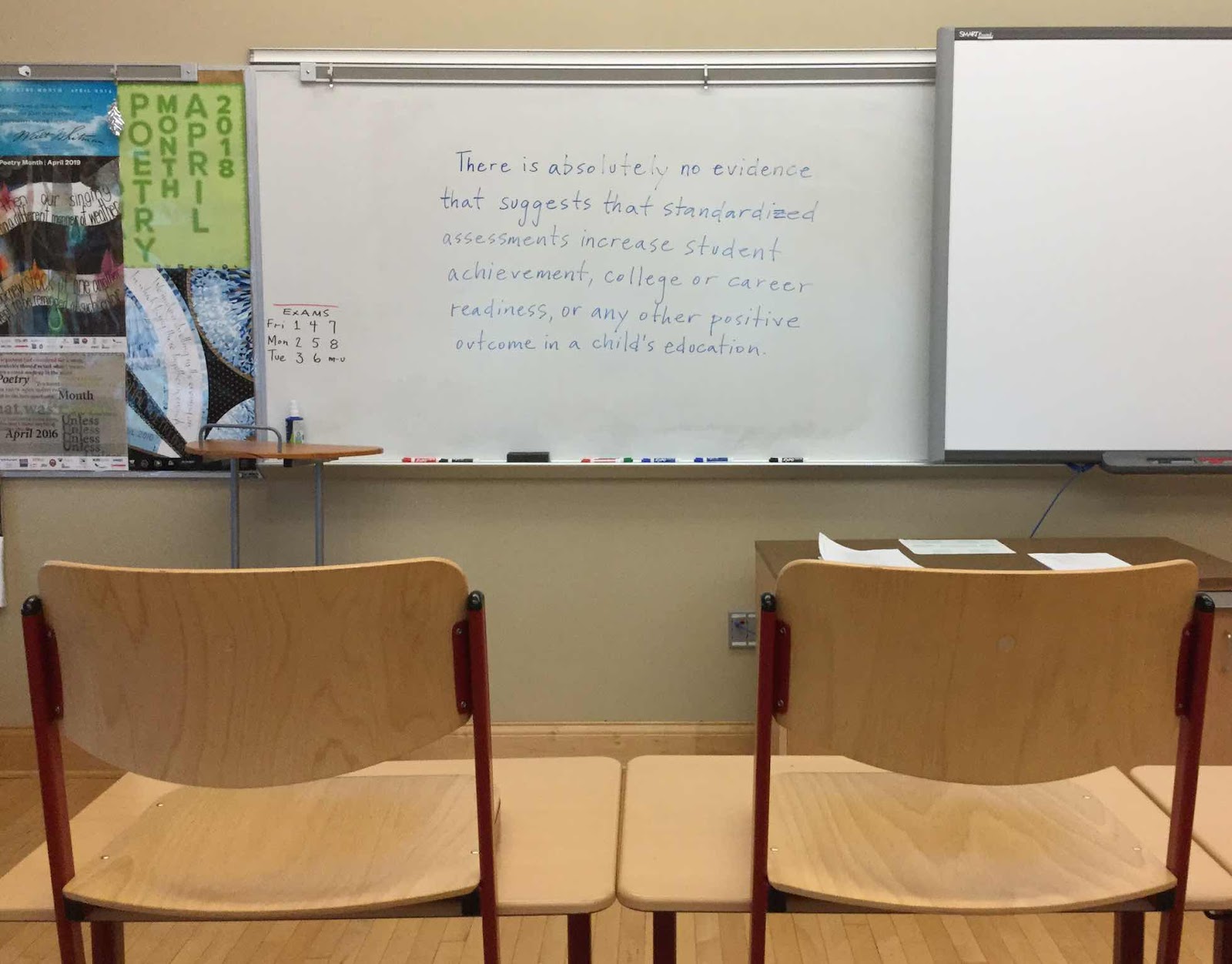
Since the passage of No Child Left Behind at the federal level in 2001, the volume of standardized tests has increased dramatically and had no impact on student achievement. Over that time period, scores on the National Assessment of Educational Progress, the largest nationally representative and continuing assessment of what America's students know and can do in various subject areas, have stagnated. SAT scores declined between 2006 and 2014, and ACT scores have been flat. There is absolutely no data in existence that suggests that standardized tests increase student achievement, college or career readiness, or any other positive outcome in a child’s education.

When the federal law changed from No Child Left Behind to the Every Student Succeeds Act, the Ohio Department of Education sought stakeholder input on the future of education in Ohio. They conducted surveys and held a series of forums statewide to collect data on how to move forward. When the ESSA stakeholder report was made public in late 2016, recommendations were dominated by “complaints of excessive testing.” Unfortunately, ODE & Superintendent DeMaria did not reduce testing as a part of the state’s ESSA Plan submitted to the federal government. After public outcry, the Superintendent agreed to form the Assessment Advisory Committee, made up of educational experts and leaders from around the state, to study and make recommendations on how to reduce testing. The Committee presented its recommendations to the State School Board in June of 2017. Among the tests they recommended for elimination are those included in House Bill 239: American History, American Government, one High School Math, one High School ELA, and the ACT/SAT requirement. At the time, Mr. DeMaria ignored the bulk of the recommendations from his own Committee, ignored the stakeholder input ODE had compiled, and only eliminated Social Studies assessments at the 4th and 6th grade levels, which were also included in the Committee recommendations.

Among his campaign promises, Governor DeWine stated that his administration would “reduce the number of tests that students are required to take.” House Bill 239 would effectively remedy the chief concern of education stakeholders in Ohio, follow the recommendations of educational experts and leaders in the state, and satisfy the Governor’s promise to his youngest constituents.

The test reduction that would result from House Bill 239 would make a child’s education more relevant, creative, and rewarding for all of those involved. Teaching, as I do, in an urban high school of approximately 2000 students, more than half of which are considered economically disadvantaged, means that success on standardized assessments is not guaranteed. Where some districts need not think about, or even mention state testing, in urban schools like ours, the assessments drive everything within the school year. 

Superintendent DeMaria likes to discuss the idea that student learning is “jagged,” meaning students learn at different rates, have different interests, and different areas of expertise. A system focused on standardization does not make any sense within the reality he describes. There is, quite simply, no time for divergent thinking, creativity, or the pursuit of areas of interest, when the curriculum must be narrowed for the sake of assessments. 

The intrusive nature of the system cannot be understated. While curriculum is criminally narrowed in the core classes, our entire school feels the impact during testing seasons. Counselors become test administrators for weeks at a time and are unavailable to students in need. Our small gym, computer labs, maker space, and classrooms become testing rooms. Technology becomes essentially unavailable for a month or more. Entire school days are devoted to testing, and when they are not, students are being pulled from classes in order to complete assessments. Reasonable teachers scale back academic activity during the testing season to optimize student effort and ability on assessments, and to avoid student burnout.

The rationale for Ohio’s excessive assessment system has been to assure that students are “career and college ready.” ODE repeated this like a mantra as if simple repetition would make it true. No data exists to prove their claim. No college references Ohio standardized test scores for the sake of admission or placement, and no employer uses these scores as a contingency in their hiring practices. Even the ACT is negligible in its function. Many colleges are abandoning the use of assessments like the ACT for admission, and it has been long accepted (including a 2014 study by the University of Chicago) that Grade Point Average is the “strongest indicator of college readiness” and is “much more predictive of college graduation than any test score.” This information supports House Bill 239’s reduction of state assessments to federal minimums, as well as the elimination of the mandate for the ACT/SAT. We have been told that forcing all high school students to take the ACT might encourage some students to attend college who may be unaware that they are capable. If their capability to graduate from college is best predicted by their high school grades, as the research indicates, then mandating the ACT is unnecessary, and quite frankly often inappropriate. In my experience, this assessment is being forced upon huge segments of the population who have no business attempting it based on their academic abilities.

It seems to me that if we were really interested in assuring that students were preparing for college or career, then we would facilitate an educational environment that does just that. In dramatically limiting standardized tests, House Bill 239 will promote “jagged” learning, differentiation, student exploration. It will make available the facilities, faculty, and resources that are being monopolized by the administration of state tests. It will free up counselors to counsel, to assist students in exploring the possibilities that exist for them as they move forward in their lives.

I have heard critics of test reduction lament the loss of data from these standardized tests. Others believe that without the tests, students will not take these courses seriously. First, any data that educators receive from ODE related to these assessments is negligible. It arrives after students have left the class, and even if it arrived earlier it is far less informative than the summative and formative assessments being administered by professional educators like myself. As for the second concern... students do not take my American History class seriously because there is a state test attached to it. They take the course seriously because this is the environment in which the course is taught, because they are students who approach their work with consideration, and because I am a professional educator who brings to the classroom a sense of seriousness, relevance, and enthusiasm regarding the subject that I teach.

At the high school level students currently take 7 assessments for the state’s Graduation Requirement. The two ELA tests are frequently administered in two separate sessions. Students retake any assessments where the scores are not high enough. They take the ACT at least once. They may take an assessment to qualify for CCP classes. They may take the ASVAB for military service, English language tests, or professional assessments related to their vocational pursuit. The volume of mandated and potential assessment is absurd. House Bill 239 brings the mandated assessments to federal minimums and requires districts to convene committees of stakeholders, including teachers, administrators, and parents to analyze and report out the level of district specific testing that occurs. 

When I first saw the information regarding HB 239, The Testing Reduction Act, I thought to myself, this is the most common sense piece of educational policy that I have ever seen. It is the logical reversal of a failed experiment in excessive standardized testing. The bill recognizes the input of stakeholders statewide, educational experts and leaders, and is in harmony with Governor DeWine’s vision for education in Ohio. Furthermore, the actions taken through this legislation are supported by the research, and begin to bring ownership of the educational experience back where it belongs, with the students. Once again, there is absolutely no evidence that suggests that standardized assessments increase student achievement, college or career readiness, or any other positive outcome in a child’s education.

Please consider supporting this bill, and thank you, again, for the opportunity to provide proponent testimony.

Matthew T. Jablonski
American History Teacher 
Elyria High School

Friday, January 4, 2019

Serendipity & Optimism.


“The DeWine-Husted Administration will reduce the number of tests that students are required to take...” 


It is a new year, and hope springs eternal.

My uncharacteristic optimism coming into 2019 has a lot to do with the total shitshow that was 2018. I may have lost my mind. You’d think by this time I’d have grown accustomed to utterly asinine education policy in the state Ohio, but it continues to wear on me...

This past year became yet another in which legislators refused to address unconstitutional and inequitable school funding. 

Despite a several year old demand by education stakeholders to reduce testing, standardized tests remain as excessive and intrusive as ever in the lives of students and teachers. 

House Bill 70’s “Youngstown Plan” continues to make a mockery of education, the democratic process, and common sense. The situation in Youngstown and Lorain has devolved into a dumpster fire of ineptitude. East Cleveland and other districts throughout the state appear poised to follow. 

Unregulated electronic, and other charter schools remain unchecked in their theft of taxpayer dollars while legislators persist in championing them.

The great achievement of the year’s end, a temporary fix to the grad problem, was resolved halfway through the school year, which amounts to at least several months (if not years) longer than the issue should’ve been allowed to go on.

So, where the hell is my optimism? It is in this...

A permanent resolution to the grad problem is in the works.

ECOT is closed.

Resistance to HB 70 is ongoing, growing, and in the courts.

In addition, leadership in Columbus appears as if they are beginning to actually listen to professionals in public education when crafting policy related to public education.

The first component of incoming Governor Mike DeWine’s “Education Plan” from his campaign website is a reduction in standardized testing in order to free up time for teaching and learning. As the website states, “The DeWine-Husted Administration will reduce the number of tests that students are required to take...” I am confident in speaking for the vast majority of my colleagues in public education on this topic when I say, “We support you wholeheartedly in this endeavor, sir.”


Fortunately, Mr. DeWine’s plan coincides perfectly with data already compiled by the Ohio Department of Education. You might recall that when the ODE asked for input on its implementation of the Every Student Succeeds Act, most stakeholders demanded a reduction in standardized testing. From an article in the Plain Dealer at that time, “‘The amount of testing was at the top, followed closely by concerns around charter schools,’ said Colleen Grady, the former Strongsville school board member who is now a senior policy advisor for the Ohio Department of Education.”

In response, State Superintendent DeMaria promised to form a committee, study the issue, and take action. The result was the elimination of Social Studies Assessments in 4th and 6th grade, with a recommendation to eliminate the American Government test in high school (which never happened). While I am not confident enough to speak for all stakeholders, when I provided my input and recommended reductions in standardized testing, eliminating only two tests is not at all what I had in mind.

With the new Governor agreeing with education stakeholders in what I can only describe as a case of glorious serendipity, it seems as if the time has come for legislators to take some meaningful action.

Namely, eliminate ALL assessments not required under federal law.

As a high school teacher at a school of nearly 2000 students, I would argue that 7 assessments as a part of the Graduation Requirement is excessive, intrusive, unnecessary, and essentially meaningless. Unfortunately, the Superintendent’s recommendation for the new Graduation Requirement, while somewhat varied and improved, maintains the administration of 7 assessments. This is clearly contrary to the wishes of education stakeholders and the Governor himself. Since state legislators have finally agreed that it is necessary to retool the requirement (based on their vote in December), and a reduction in assessment aligns not only with stakeholder input, but also with the Governor’s Education Plan, eliminating at least a few tests is only logical.

In the spirit of my (perhaps misguided) serendipitous optimism, my first political act of the new year is going to be to contact all Ohio Legislators with this idea. I’d encourage you to do the same.

Tuesday, September 4, 2018

It’s Always Something (a post for the start of the school year).


Today is the first day of school in my district, and I’m sitting at home due to a heat index set to hit above 95 degrees. Much as I hate to use the phrase “It’s always something,” it’s always something.

As a matter of fact, last week, a few colleagues and I had just finished some professional development on how to identify bed bugs, proper use of an epi-pen, and the details of a mass evacuation in the case of a bomb threat, or lock-down should there be an active shooter, when I asked them what they thought it would be this year.

Without hesitation they knew what I meant, and Amanda said, “Tuberculosis.” I nodded, believing this was a reasonable answer, and legitimately figured that it has been awhile, and we’re probably due. Of course, it’s also been awhile since our locale became one of the first cities in the country to have a confirmed case of swine flu, waves of bomb threats, etcetera. All of this is beside the point.

It’s always something.

Having given it some more thought, I believe that the answer to my own question is that this will be the year that the state of Ohio abandons its senior class. Believe me when I say that I really hope that I’m wrong, just as I hope that none of the other horrors visited upon classrooms nationwide rear their ugly head. It just seems to me that there is simply too much backward thinking on the graduation requirement, and an article in the Dayton Daily News only further confirms my fear..

I sat down with my legislators in July to convey the reality of the situation at my high school. Basically, an alarming number of students are unable to earn the 18 points on 7 assessments, necessary for graduation. To be specific, of the 438 graduates from the high school where I teach, 148 graduated through the “Additional Pathways,” which permitted 2018 graduates to use a means other than assessments to prove they were deserving of a diploma. All things considered, if not for the pathways, I believe that these numbers would have boiled down to a Graduation Rate of around 60% in a school whose rate is typically 85% (give or take).

Further complicating the issue, I told them, is that the Ohio Department of Education claims that the 18 points are the threshold at which students prove that they are “college and career ready,” despite the fact that no data driven analysis by the state, or anyone else for that matter, can prove this claim. No college references state test scores to predict success (most look to GPA for that), & no employer is looking at these scores as a part of their hiring practices.

Add to all of this the fact that the State Board of Education recommended in January to extend those Additional Pathways for the classes of 2019 & 2020, big urban districts are reporting the potential of 50% non-graduates, and even the affluent burbs say 10-20% needed the pathways, and the solution seems obvious. And yet...

In Jeremy Kelley’s DDN article Republican Senator Peggy Lehner, Chair of the Senate Education Committee says, “At this point I can’t say for sure that anything will be done. I am certainly looking at the data very closely, and I’m going to be encouraging my colleagues to do likewise.”

With due respect to Senator Lehner & her colleagues as they consider a deep dive into that data, the system you have thus far failed to change does not measure what it claims to measure, and seeks to prevent the receipt of diplomas among some of Ohio’s most vulnerable students, lots of them. I do not believe it’s an exaggeration to say that the ramifications of this scenario on their lives, the lives of their families, the health of their communities, the economy, and the entire state of Ohio is quite dire.

Unfortunately, the Ohio Department of Education doesn’t seem to get it either.

The ODE’s representative Chris Woolard said, “I think the real question here is, what’s the graduation rate going to be, and is it going to be significantly different? I can’t answer that question.”

Well, fortunately for Mr. Woolard, every single representative of a public school who has commented on this situation has answered that question. The answer Chris, is YES, THE GRAD RATE IS GOING TO BE SIGNIFICANTLY LOWER! Sweet Fancy Moses, one would think that the Ohio Department of Education might listen to a Superintendent. They’ve spent 4 years ignoring what I’ve got to say on the topic, but I’m just a teacher.

Then, he doubles down on his lack of understanding... “Based on where we saw things six months ago, from an on-track perspective, things looked better than what people were concerned about two years ago.”

No, no, no, no. Six month’s ago, two years ago, 4 years ago, critics of the grad system like myself have been saying that big urban districts would see grad rates around 50%, smaller urbans at 60%, and so on. Believe me, I remember suggesting this and thinking that it would be awful whether I was right or wrong. If I was wrong, then I look like a paranoid wackaloon (but at least kids are graduating), and if I’m right, then we find ourselves right where we are. We weren’t wrong.

The ODE is officially painting a rosy picture as they persist in attempting to polish the turd that is their Graduation Requirement while the Ohio Legislature isn’t sure whether or not they’ll remedy their broken and meaningless system.

Sound about right?

It’s always something.

Friday, July 13, 2018

Congratulations Graduates, Don’t Listen to the Naysayers.


First of all, congratulations to Ohio’s high school graduates in the class of 2018, especially those who were able to use the additional pathways to obtain your diploma.You are the first group of young Ohioans in several decades who’ve not been wrongly prevented from graduating due to a meaningless and obtuse assessment system.

According to an article from the Plain Dealer’s Patrick O’Donnell more than a third of students in the urban areas he surveyed would not have graduated if the assessments alone were used as the measure for graduation. I realize that the Ohio Department of Education & other advocates of the system would argue that there were three pathways to graduation beyond the state tests, prior to the additional pathway. To which I would retort, one is a remediation free score on the ACT/SAT, an assessment, and the other is an Industry Recognized Credential, also requiring assessments.

So... good for you young people, but if you decide to read the article, beware there are a couple of naysayers who would attempt to diminish your accomplishment. They are advocates of the “rigor” (bullshit meaningless word they like to use) of the new assessment system & grad requirements.

Representative Andrew Brenner, Chair of the House Education Committee, is quoted in the article asking, "What's going on here that they're not able to get kids up to being college and career-ready?" He is completely off base here on several levels.

First, he is referring to teachers in urban districts where more students were unable to meet the points on the assessments in order to graduate. What Mr. Brenner fails to recognize is that students in these districts have a greater likelihood of being economically disadvantaged, which is widely recognized as having a negative impact on a student’s education  After all, an individual will be more concerned about their next meal, caring for siblings, a lack of health care, housing or transportation instability, & other related issues than they will be about the remote details of Algebra, American History, or Biology.

At the heart of Brenner’s nonsense, however, is his terribly dubious claim that the state’s requirement of 18 points on 7 assessments equals college & career readiness. There has, to my knowledge, never been a data driven analysis to indicate that this is true. We are simply expected to believe it because Mr. Brenner, and others of his ilk, repeat the phrase so often. As a matter of fact, the other assessment advocate & naysayer referenced in the article, Chad Aldis of the Fordham Institute, has often made this claim. When I questioned him about his claim of readiness after Fordham penned an attack on Akron Superintendent David James this week, he admitted that he has no idea whether or not the requirement actually measures college & career readiness.


Mr. Aldis does not make the CCR claim in this most recent article, but calls the additional pathways “absurdly easy” and the diplomas “meaningless.” He also suggests that if teachers like me simply worked harder, then students would perform better on the tests. With due respect to Mr. Aldis, (whose employer is an advocate for, & sponsor of charter schools who benefit from public schools being labeled as failures by state testing systems) we teachers could work ourselves to madness or death, but that would not make this assessment system any more meaningful. You and Mr. Brenner would still not be able to find a single college that refers to score from Ohio’s assessment system for use as a predictor of college success. Furthermore, you will be unable to find an employer whose hiring policy is dependent upon scores on Ohio’s state tests.

As for the difficulty of the additional pathways, we know that more students graduated under this system. I find this to be a fantastic development. The idea of “too many kids graduating” is beyond my comprehension.

If we are legitimately interested in assuring that students are ready for life after high school, then wouldn’t the components of the additional pathways... work experience, volunteer work, maintenance of a Grade Point Average (the greatest predictor of college success), and other items of the sort be vital to that end? Sure working 120 hours might be “absurdly easy” in the mind of Mr. Aldis, but I’ve had some jobs where I’d classify that time as nightmarish, but where I learned some important lessons about work ethic, collaboration and communication, if not the necessity of staying in school in order to avoid shitty jobs. These experiences were sometimes more valuable than those in the classroom, and certainly more validating than a score on an assessment.

The Graduation Requirement does not have to be impossible, or even terribly difficult, in order to be meaningful.

What Rep Brenner, Mr. Aldis, & other pro-assessment shills like them are attempting to do is to infuse meaning into a meaningless assessment system, and because the media repeats their unfounded opinions as fact, people believe them. They would have us believe that the only thing of value accomplished by students in their educational career is a collection of test scores.

They are wrong.

Perhaps instead of giving Brenner & Aldis the opportunity to trot out their same tired, unfounded line of bullshit the next time an article is written about graduation in Ohio, the reporter will give me a call. I’ll congratulate ALL of the graduates on their meaningful accomplishment despite an utterly meaningless assessment system.

Friday, June 22, 2018

Our Education Policy Priority is Nonsense.


Allow me to put this in perspective. At the high school where I teach, approximately 200 of 450 seniors in the class of 2018 were using the additional pathways to earn their diploma. For those of you out of the loop, this means that they were unable to earn 18 points from the state’s 7 assessments, or particular point values in content areas. Statistically speaking, the tests that have given students the most trouble, both at my school and statewide, are Algebra and Geometry.

Unable to earn the scores deemed appropriate & indicative of college & career readiness by the state (with no data driven analysis to prove the readiness they claim), these seniors worked to complete their coursework successfully while simultaneously studying in remediation (test prep) classes in order to retake problematic assessments. They were also required to satisfy 2 components, or additional pathways, to earn their diploma. At my school, overworked administrators and counselors met individually, frequently with students and tracked their progress on 3 possible pathways selected by the student. This way, if a student found themselves unable to meet 93% attendance, often difficult among economically disadvantaged students for health care and transportation issues, those students could focus on attaining the necessary GPA, or score on the WorkKeys assessment, or hours in employment or volunteer service, or another of the additional pathways.

Setting aside the fact that the inordinate amount of time and effort expended could have been better used to actually counsel students regarding their mental health, career choices, college options, scholarship info, etcetera, the system created seemed to work. It is gloriously pointless, does nothing to encourage appropriate life choices for students, is a fantastic waste of resources, but at least students were able to graduate.

I bring all of this up now despite this being my first full week of summer break, a time in which I should be sitting quietly in my backyard, staring blankly into the distance as my mind makes sense of the past school year, a bemused smile on my face, a cat circling my ankles. I bring this up because I keep waking up with uncertainty, the uncertainty of a man who knows that in a few short months the class of 2019 will be stepping into the school in which I teach with no alternative pathways to graduation outside of a meaningless assessment system.

If the numbers are comparable to last year, and every measure we’ve seen indicates that they will be, then somewhere around 50% of seniors (give or take) in every urban district will be starting the year with some measure of anxiety regarding whether or not they will receive a diploma. Half of those kids might have a shot, despite already having retaken their Algebra assessment 2 or 3 times to no avail, so will show up and bust their asses even though the odds are steep.

At the other end are those kids who’ve got maybe 9-11 of their necessary 18 points having already taken all of the tests, who know damn well that the system has been stacked against them to such a degree that there is no way in hell that they will improve that many test scores and graduate, despite all of the remediation, hard work, and best intentions of teachers, counselors, and administrators.

“Why bother showing up?” is likely the question that will enter many of their minds, and I’m not sure that I have a good answer.

A bill exists right now that would extend the pathways for the classes of 2019 & 2020 until a more meaningful Graduation Requirement can be crafted. House Bill 630, introduced by Representative Galonski, awaits the appropriate hearings which have yet to be scheduled by House Education Committee Chair Andrew Brenner. Rep Brenner told the media that there would be action taken on graduation when the state board recommended it in January. He called me at my home and told me the same.

And yet, no action. Not on graduation anyway. Mr. Brenner’s bill that would require the State School Board to develop a cursive handwriting curriculum passed the House this week. While the class of 2019 twists in the wind, our education policy priority is nonsense.

Tuesday, June 12, 2018

Sparrows, Absurdity, Contradiction, Purposeful Ignorance, & the Right Thing to Do.


In the spring, outside my classroom, on the window ledges of this hundred year old building, the sparrows call to one another in something of a song. It is idyllic. The morning sun angling through the third floor blinds casts shadows onto the wood floors while I’m seated at my desk prepping the day’s materials. And through this, the sparrows call to claim their territory.

We have reached the end of the school year again, late this time due to our post-Labor Day beginning. The lateness has afforded our students the opportunity, for better or worse, to see their state test scores prior to leaving for the summer. Unfortunately, just like last year, there has been no long term solution established regarding the Graduation Problem, and no short term extension of the additional pathways to graduation for the classes of 2019 & 2020 as recommended by the State School Board. 

What this means is that sophomores and juniors have only their assessment scores as a path to graduation, and for many of them (50% or more in the urban districts) this is an unsettling uncertainty.

I’m not sure any of us arguing for a solution are terribly surprised by this lack of action from the Ohio Legislature. After all, a Republican majority in the House took months just to choose a new Speaker. Ohio suffers nearly triple the US average in opioid overdoses, and this same leadership has done little to remedy that situation. Ohio’s poverty rate exceeds the national average, and yet Republican gubernatorial hopeful Mike Dewine supports rolling back Medicaid expansion, potentially stripping poor families of their health care. Meanwhile, the state has as yet been unable to reclaim the 80 million in tax dollars taken fraudulently by ECOT, and some Ohio politicians still celebrate its accomplishments. We have plenty of fish to fry here in Ohio.

Why should I care so much about graduation when students don’t have enough to eat, and issues with addiction tear families apart, while politicians celebrate low unemployment while ignoring poverty, children are being taken from their parents by federal agents, and we’re being encouraged to consider Canada as a threat. The world is filled with absurdity and contradiction, gross inequality, and purposeful ignorance.

Each problem alone is built in this way. The graduation problem is the same, and as a high school teacher this is the issue at which I’ve chosen to take my swings. As I’ve indicated many times before, Ohio is one of only 13 states to require assessments for graduation. Advocates of the system make the dubious claim that the assessments assure that a student is college & career ready. Of course, no proof exists that standardized tests prove either of these things. Ohio leaders insist otherwise with no data to back up their assertion. When questioned on this punitive use of tests, they often become agitated, and suggest I’d hand out diplomas to kids for doing nothing.

In response to that, I suggest that the wealth of coursework taken during a student’s four years in high school (not to mention their efforts PK-8) are sufficient to qualify as achievement, and are certainly not, as they say, “nothing.” So far, Ohio Legislators have not wanted to hear my ideas on this issue, however thoughtful or data driven they may be.

Standardized tests best correlate to economic status. Generations of testing data prove this and yet policy makers refuse to acknowledge reality. For them, the assessment score seems to be the only item of value produced by a student throughout their educational career. This thought process has created in Ohio a situation where leaders believe that we are encouraging our children in poverty by punishing them by withholding diplomas. Again, absurdity, contradiction, gross inequality, and purposeful ignorance.

The consensus in Columbus seems to be that we could possibly allow too many students to graduate. I understand the idea of raising expectations and preparing students for the future, but nothing suggests that assessment based punishment is working to that end. And to be fair, higher expectations are contradictory to the state’s policies on other educational issues.

Ohio wants its students to seek career training, vocational credentials, & college degrees, but legislates in favor of charter schools that can be run by individuals with no experience in education. Districts that face HB 70 style takeovers are riddled with criminal absurdity. In Lorain, an unqualified CEO, a veteran of slapdash training in Teach for America, hires uncertified administrators to lead a severely economically disadvantaged district, promising that all future graduates will either be credentialed or have a degree in addition to their diploma. But the district leaders don’t have the appropriate credentials?!

Asking me to believe that complete deregulation of education in empoverished urban centers, and that often uneducated, unqualified, & uncertified personnel are best suited to encourage students to seek education and certification makes as much sense as asking me to believe that Canada is a threat, or that withholding diplomas due to test scores is in the best interest of students.

I cannot let go of the graduation issue because I see the terrible interconnectedness of many of these things. Poverty correlates to low test scores, and low test scores currently prevent graduation. I believe that preventing 40-50% (maybe more) of students in urban areas from earning a diploma based on a meaningless assessment system will only exacerbate poverty, potentially compound the opioid epidemic, & create more problems.

One of my students this year asked me what I get for all of this. “Like what do you get paid,” she asked, for following legislation, writing articles, communicating with (& getting insulted by) policy-makers, working toward fixing the graduation problem? “Nothing,” I told her. “There’s no, like, extra payment or anything.” 

This small interaction really made me wonder why I keep after it. I’m tired, demoralized, and sometimes physically sick over this shit. Leadership in Columbus consistently fails to see my side of the argument. Why bother?

First, I am bemused by the absurdity that is being passed off as education policy.

Second, children are being done wrong, so it is the right thing to do.

And finally, I’m territorial just like these sparrows. My students deserve a better system.


Friday, April 20, 2018

I coulda been a contender. I coulda been somebody.


“You don't understand. I coulda had class. I coulda been a contender. I coulda been somebody, instead of a bum, which is what I am, let's face it.”

Ever since I provided feedback on the Ohio Strategic Plan for Education  I’ve been thinking about this quote. You see, the plan embraces a holistic view of education, one that seeks to allow children to develop academically through diverse coursework in order to pursue their interests, become creative and critical thinkers, and learn about their place in their community and the world. 

The plan presents 4 “Equally-Valued Domains of Learning” that include the academic skills & knowledge, but also creativity & analysis, well-rounded content, and social-emotional skills. There are specific references to promoting the arts, wraparound services to help remediate the effects of poverty, and promoting student interest and career driven exploration through choices. These are precisely the ideas that make school a valuable experience, and even fun.

Furthermore, these ideas coincide with much of my own reasoning in going into the field of education. As a young teacher I was interested in building relationships, offering choices and opportunities for students to learn about themselves and their world...to develop, in the words of the Strategic Plan, lifelong learners. Then things went awry. No Child Left Behind placed an inordinate focus on standardized assessments, and the state of Ohio cranked up the high stakes to include promotion, graduation, teacher & district ratings, and all sorts of irrelevant punishments.

Our focus had to shift. My focus turned to the kids who primarily needed to pass tests in order to graduate. Sure, I’ve worked to infuse interest and creativity, choice and exploration, communication, critical thought, social-emotional development...fun. The reality, however, is that all of these things remain secondary (at best) in a system reliant upon high-stakes standardized tests.

I could’ve been a great teacher.


The Strategic Plan is lacking an adequate sense of reality. Its EachChild, or Whole Child view is contradicted by the existing system, and there is absolutely nothing in the plan to suggest that the existing system will change to facilitate these valid expansive ideas. 

In an education system saturated by standardized tests, where their outcomes determine promotion and graduation, evaluation results, success of levies (so economic stability), and potential district takeover by the state (Youngstown & Lorain currently), the educational focus must remain on the assessments. In districts where assessments scores suffer (read impoverished districts), an inordinate focus will remain on  ELA & math, as well as other tested subjects as necessary. 

This is a focus on a single domain, Foundational Skills and Knowledge. There is simply no time or resources to devote to the other domains. Opportunities for creativity lack in the current system. Art, music, phys ed, and electives are sacrificed for attempts at success on high stakes assessments. Social and Emotional growth becomes secondary to the numbers on assessments.

As long as there is punishment attached to tests, schools will purchase Chromebooks to administer assessments instead of hiring art teachers. They will invest in reading software that mimics assessment questions instead of organizing field trips. Our gymnasiums will continue to turn into testing rooms. Our Counselors will primarily serve as Test Administrators. Teachers will continue narrowing their focus to the tested material, and student experiences will continue to be limited.

Sure, affluent districts that do not even need to think about the assessments will continue to move forward promoting all domains, while less affluent students will suffer under a system that has not promoted growth over the last 20 years. With this said, all Ohio’s Strategic Plan will do is to highlight the inequality that exists, while its vision is supposed to be one of equity.

Without significantly dismantling the current system by moving toward federal minimums in assessment, eliminating all high-stakes associated with assessments, and fixing school funding, the Vision, Goals, and Strategies in Ohio’s Strategic Plan for Education are utterly meaningless. I appreciate the work that has clearly gone into the Strategic Plan, but it is once again attempting to shoehorn reform into a system based on punishment. It simply will not work.

A Few Other Thoughts for the Ohio Department of Education on the Strategic Plan.

1) Standardized Assessments are not "robust measures." Stop with this nonsense. Recognize that poverty impacts education, and that this is what your assessments measure. Then move forward with remediation of poverty through wraparound services as indicated.


2) Recognize the innate problems with a high-stakes assessment system. (3rd grade, Graduation Requirement, Teacher Evaluation, District Takeovers are not accomplishing what you believe or claim)


3) Do not pretend that Teach for America has been successful. It hasn't. It brings less qualified individuals into the classroom. Then they leave the profession after a short time, which provides little consistency, harms children, and the educational culture in schools. Similar programs for administrators are unproven as well.


4) Personalized learning is unproven in the research, as are digital methods. Presenting them as viable is terribly misguided.


5) Actually follow the feedback on the Strategic Plan given to you in the Stakeholder Meetings, and through the Survey by educators like myself. You didn't do this with the ESSA plan until we all called you on it. Your actions have been disingenuous and disrespectful. I’m not a bum. Don’t treat me like it.

Friday, April 6, 2018

24 Giant Sized Brillo Soap Pads, 240,000 Educators, 1.7 Million Children, & One Lie of an Assessment System.


I woke up with three days of spring break to go. I’d planned to go to the Allen Art Museum, and get home in time for the Indians home opener. This was supposed to wash away the mess of sickness, departure, and funerals of the last month, the waves of political opportunists using school safety to make us all feel unsafe in order to get elected. I just wanted to forget about that shit, so I could begin to get ready for the run in with my sophomores to the state assessments over the next few weeks, and maybe still find some fun in teaching.

I already feel like a liar, for the degree to which I’ve got to pretend to take the state tests seriously. Anyone paying attention knows that they best reflect socio-economic status. To tie them to graduation makes little sense, but the law is the law, and my students need to score well in order to graduate. As a teacher, I have to manufacture a requisite level of seriousness with regard to the assessments. I’m sick of it. 

The Ohio Department of Education and state leaders like Superintendent DeMaria and Governor Kasich believe the tests somehow measure college and career readiness, despite an utter lack of data to prove their assertion, and the fact that colleges generally recognize GPA as the greatest predictor of college success. Our task as educators at the secondary level has become something of a farce.

To make matters worse Superintendent DeMaria is currently busy traveling the state, celebrating the Strategic Plan for Education in Ohio, being transparent, “listening” as he takes in stakeholder input on the plan. Here’s an excerpt...

“The aim of this comprehensive strategic plan for education is to create the conditions for EachChild to reach success through the guidance and support of caring adults who are empowered by a system continually evolving to meet the needs of every student.”

This would be great if Superintendent DeMaria hadn’t been “transparent” and listened to stakeholder input on the ESSA plan, only to completely ignore the input on minimizing assessments until he was called out on his bullshit. Don’t get me wrong, I think teachers and other stakeholders should still provide input regarding the state’s education plan, but more importantly should be outraged and call them out on their hypocrisy.

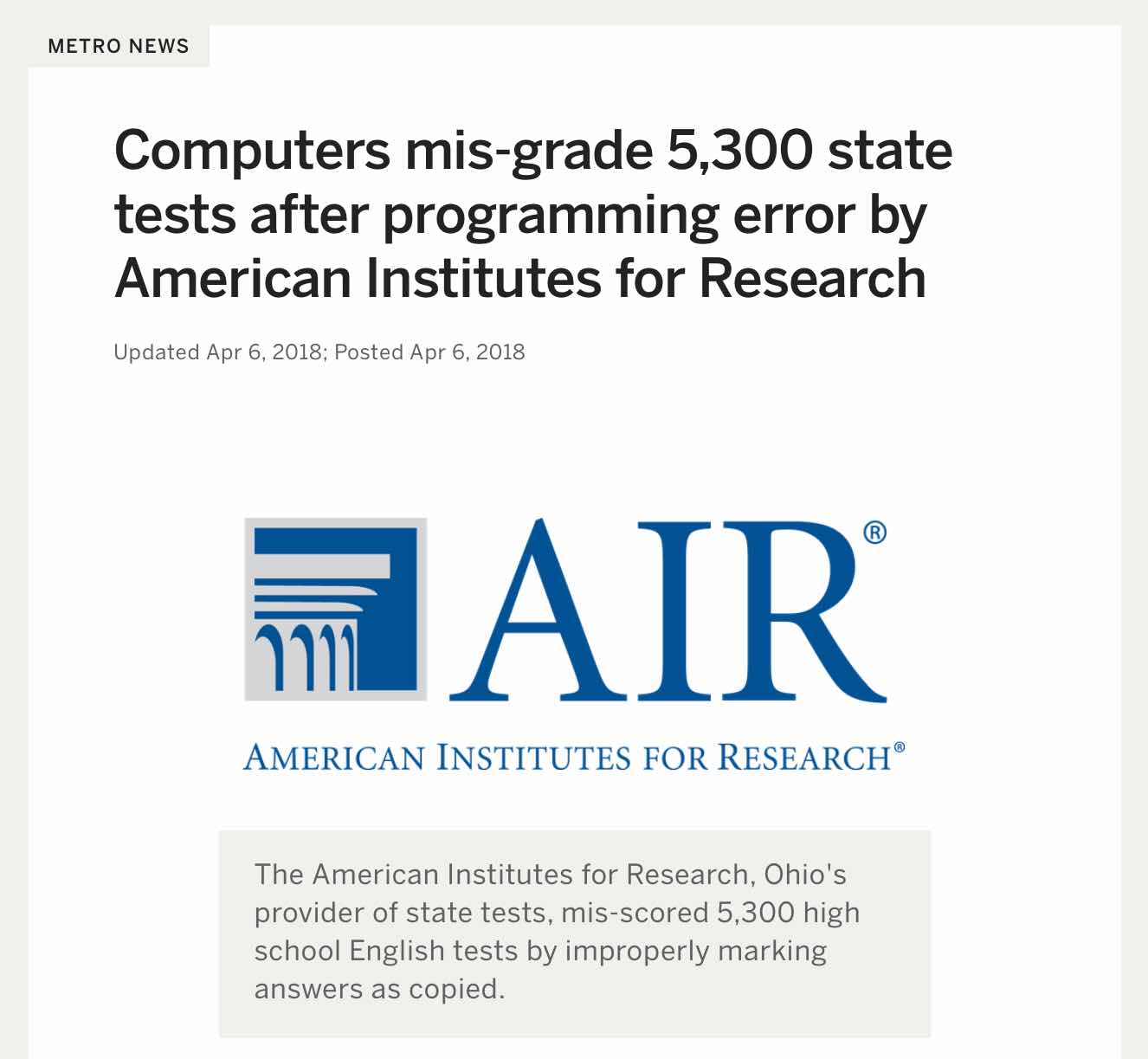
My outrage shook me upon my return from the museum. All of the depth of calm I’d achieved in proximity to Neel, Monet’s Wisteria, Warhol, and Lichtenstein was reduced to anger at the headline below...


The story indicates that thousands of English Language Arts tests at the freshman and sophomore level were scored incorrectly due to human error, but had been fixed. Incorrect scores were delivered to schools, so students, not knowing any better, likely became further demoralized regarding their graduation prospects, many likely scheduled and began remediation classes as they prepped themselves for another go at the tests.

What?

How much “human error” has gone unrecognized?

How many tests were incorrectly graded, and recognized, that we haven’t been told about?

How many 3rd graders have been held back due to incorrect scores?

How many diploma’s have been, and will be withheld for the reason of incorrect scores?

This is bullshit.

Yes, the Ohio Department of Education assures us that these are the only issue, and they’re fixed, but it’s been quite some time since I’ve trusted anything from the ODE.

And they’d like me to weigh in on the Strategic Plan? Sweet Fancy Moses.

First of all, these are not the conditions under which children can be expected to reach success. 

Furthermore, while I am a caring adult in the business of education, I am NOT empowered by this system, nor are my students. As a matter of fact, the ODE’s system seems like one that has been designed to trick, fool, lie to, and fail us, whether we are, or are not successful. In my mind, the Ohio Department of Education has lost its credibility. It has lied on behalf of charter schools to manipulate ratings. It has perpetuated an assessment system that elevates the rich and demonizes the poor. It has championed a graduation requirement that it cannot prove establishes college readiness. And all the while, the ODE and Superintendent DeMaria travel the state with their nonsense rhetoric...

“Ohio’s future is powered by its education system. Today, more than 240,000 educators work in 3,500 schools to serve more than 1.7 million CHILDREN—our most precious asset. Ohio benefits from a dedicated group of CARING ADULTS who inspire and guide children and prepare them for an exciting future.”

“Our most precious asset” is being served by a system riddled with inequity, punished by assessments whose chief accomplishment (whether the scores are lies or truth) is celebrating the rich, while demonizing the poor.

If Superintendent DeMaria’s Strategic Plan is worth any more than the paper on which it is printed, then he and the State Legislature need to internalize the idea that Ohio’s education system should be “continually evolving to meet the needs of every student.” With that accomplished, Ohio’s standardized assessments need to be removed from any high stakes decisions regarding student promotion and graduation.

Until that occurs, we will be forced to call this assessment system what it is, bullshit.

Sunday, March 4, 2018

Dumbfounded. A Few Words in Opposition to House Bill 512


“...the percentage of students meeting required scores on end of course exams is roughly the same as it was when students needed to pass the Ohio Graduation Test.” So said former Kasich appointee and former President of the State School Board, Tom Gunlock, in testimony this week in favor of HB512, the bill that would eliminate the power of the State School Board and turn it over to the Governor.

When I saw that Gunlock was back testifying, setting himself up like some kind of expert regarding education and business, I rolled my eyes. The guy got his job on the state board through appointment, and the bulk of his business career has been with his family’s company (again, by appointment). He, along with Todd Jones, were the bullies of the board, shills for a misguided education policy based on excessive assessment, overbearing evaluation, and punishment. When presented with legitimate evidence that these policies didn’t work, they grumbled and ignored the facts.

When I read the above quote, I threw up in my mouth. Passing rates like the OGT? And he is presenting this pile of shit to a House Committee as if it were factual. He is either terribly misinformed, or lying in the hope that passage of HB512 will result in his return to power as the head of the bill’s megadepartment, which combines K12 Education, Higher Education, & Workforce Development under an appointee of the Governor.

His testimony is dangerous.

At the high school where I teach, from a senior class of fewer than 500 students, more than 200 are being tracked because they ARE NOT meeting the required scores on the end of course assessments. I am willing to bet that my school is not an anomaly. Fortunately, the currently democratically elected (in part) State School Board encouraged the state legislature to provide additional pathways for these students. Without these pathways, my school that had a 90% graduation rate a few years ago would be looking at a grad rate of 60-70%, optimistically.

In a system devised by our Associate Principal in charge of assessments...let me pause here. Yes, there is a building level administrator tasked with scheduling, tracking, and administering state assessments, as well as monitoring progress to graduation. I’m sure it is exactly as awful as it sounds. Anyway, this individual devised a system by which each student would be assigned a counselor who would assure that they signed a contract to move forward with 3 of the potential pathways for the class of 2018, & attend remediation and retest where necessary. The counselors would then maintain contact, and track the progress of their set of students.

It should be noted that the counselors indicated above are still responsible for the progress, scheduling, and college or vocational application processes for their usual contingent of roughly 500 students, as well as being the group of people who administer what I can only imagine are tens of thousands of assessments and retakes throughout the year. As a matter of fact, we bring in a few retired counselors at certain points during the year, the recent administration of the ACT was one, not to “counsel” students, but to assist with the administration of state assessments.

Perhaps if we provided time for our counselors to counsel, then these students might have better guidance on their paths to career and college readiness. In light of recent events, freeing up counselors to counsel would also go a long way toward providing students in need with the mental health services appropriate to their situation, and increase school safety.

Instead, Governor Kasich is championing House Bill 512, eliminating the power of the largely democratically elected school board, in favor of a megadepartment headed by an appointee who is likely to be just as ill-informed, asinine, and boorish as Mr. Gunlock. The Governor defended his decision by saying that most people don’t even know who their board member is, anyway.

On February 1st, I emailed every State School Board Member to explain that, contrary to the opinions of Mr. Gunlock, the Graduation Requirement is still a Graduation Problem. I thanked them for their attention to this issue that is so very important to students in my school. I also encouraged them to extend the additional pathways for 2018 to the classes of 2019 and 2020, so that a suitable long term solution to this issue can be crafted in an informed manner. 

That night I received a phone call from Board Member Pat Bruns to discuss the issue. Over the next week, I heard from Board Members Manchester, Johnson, Haycock, Kohler, McGuire, Fowler, Woods, and Bruns again. On other occasions, I have had personal conversations regarding the issues of assessments and graduation with Board Members Dodd, Johnson, and Fowler, as well as former Board Member McGervey. It is largely due to the courage of former Board Member A.J. Wagner, with whom I have also spoken and corresponded, that the Graduation Problem was even recognized.

This is significant. I am a teacher, an expert in my field if I may be so bold, and these individuals have been open to my input. Unlike Mr. Gunlock, my family is unable to donate tens of thousands of dollars to a campaign in order to bend the ear, or seek an appointment from an elected official. I am reliant upon elected officials who are willing to listen, and legitimately serve the interests of their constituents based upon the facts at hand.

Let it be be said that I am fortunate enough to currently have representation in Columbus in both the House and Senate who value my opinion on education policy because of my experience as a teacher. None of these things that I have written is a slight on the quality of their service. It is, I believe, evidence of the importance of the policy shaping role of the State School Board. Furthermore, these things I have described here are proof of the importance of civic engagement in a democracy. House Bill 512 seeks to undermine this democratic spirit. It undermines my professional efforts as a teacher, and it undermines the potential success of my students.

Tuesday, February 13, 2018

Hey Ohio, They Are Not Standards Written With Teacher Input If You Completely Ignore the Input.


Why bother? I’ve been asking this question all afternoon and I’m not even sure who I’m asking.

If I’m asking the Ohio Department of Education, the question is, “Why bother asking for teacher, and other stakeholder feedback if you’re not going to use it?” If I’m asking myself, the question is “Why bother respond when they ask for feedback?

I recently responded to feedback, for the 2nd time, regarding the Ohio Learning Standards in Social Studies for American History, the course I teach. When we saw the results for the first round of feedback on the Standards, the ODE reported that nearly ALL those who participated indicated that the inclusion of the Historic Documents in the American History curriculum is redundant, they’re also taught in 8th grade and American Government, and inappropriate in the curriculum. The documents (Declaration of Independence, Constitution, Federalist & Anti-Federalist Papers, Northwest Ordinance, Bill of Rights, off the top of my head) ALL fall well outside the time frame of the American History course, 1865-present.

So, after the first round of stakeholder input, the ODE indicated that consensus dictated the removal of the Historic Documents for American History. My colleagues and I cheered the logic and wisdom of such a system that responds proactively to teacher input. 

Today when I returned to weigh in on another round of the revision, the Historic Documents remained. What fresh hell is this? Despite professional expert testimony to the contrary, the docs are still there, just as redundant and inappropriate as before, but now further tainted by deception.

Any educator, and many non-educators, can see why this would make no sense. I’ve explained it above... it’s repetitive and utterly out of academic context. Students learn for the long term by making connections. They connect new content to other content and existing schema, their prior knowledge. If the new content, in this case the Documents, is remote from the course of study, then the ability to facilitate these connections diminishes. 

Furthermore, if the ODE and legislature are so very concerned about students being college and career ready, then why on earth would we teach the same damn material over and over?

The reason, of course, is that Senator Larry Obhof believes that he has taken part in a supreme act of patriotism having passed the so-called “Founding Fathers Bill” which requires the redundant teaching of the documents. Don’t get me wrong, I do not question the good Senator’s patriotism, nor do I object to the documents being taught (where appropriate in the Social Studies curriculum). What I do object to is the refusal of legislators, Senator Obhof among them, who refuse to listen to experts in the field when making decisions that impact said field.

And in this case, the refusal of the Ohio Department of Education and Superintendent Paolo DeMaria to champion a logical and correct curricular adjustment recommended by experts in the field. Again, their own report on the analysis of the American History Standards indicated that the documents were the biggest issue in need of attention.

I participated in the ESSA stakeholder meetings, and then watched DeMaria and the ODE attempt to submit a plan that did not reflect the recommendations of those groups. Only public outcry changed that scenario. Now I’m seeing the same sort of chicanery in seeking feedback on State Standards. It makes me wonder what similar bullshit went down with educator recommendations for the Math and ELA Standards.

As DeMaria travels the state claiming to be listening to students, teachers, administrators, and others from Cleveland to Columbus and elsewhere, I’m left to wonder whether the glad handing consensus builder is genuine. I’ve had conversations with people who like DeMaria, believe that he’s listening, changing the culture at the ODE toward something positive. I met him once briefly, and he was pleasant enough. I want to believe we’re on the same team, but these circumstances are problematic. 

The Ohio Department of Education is supposed to provide support for educators statewide. They should be presenting the legitimate feedback-based changes to the state board. In this case, because for some absurd reason the legislature decided to write specific curriculum into law, the ODE and DeMaria need to be influencing legislators to act on behalf of the experts in the field. 

Instead they figured to pass this pile of shit “revision” off as if nothing happened.

If you didn’t plan to do your job, then why bother asking for input?